Minkowski, the black-matter panther
The bend.
One figure, not two. He does not shine, so he is not on the light. You hear the lines lean. A bent line arrives as a lower note.
PHIL 802 · 12 October
01 About
Kinga Kulcsar
for Professor Dr. Elina Staikou
The world-line as point, in the Pocket Universe.
When a history is seen end-on and appears as one instant, has duration been destroyed, or has it only been hidden from one view?
Every image of a moving thing makes a quiet decision about time. Turn the history until it runs straight toward the eye, and the whole line collapses into a dot. A history seen end-on looks like a single instant.
This paper is about that one visual fact. The site is The Pocket Universe, a small vacuum chamber in Los Angeles, under Quantum Picture Television. Plasma, sound, and rendered trails are built there as histories, not drawn as pictures.
Chapter one
What is space and time for you?
The question is whether a thing we meet as a point still has a history. A dot, a chair, a pixel: each is offered as one object in space. The paper asks what that object is if time is included. If the point is only the end-on view of a line, then space and time are not two containers the thing sits in. The thing is the line, and the point is how the line looks from here.
“Henceforth space by itself, and time by itself, are doomed to fade away into mere shadows.”Minkowski, “Space and Time,” 1908
“Time, conceived under the form of an unbounded and homogeneous medium, is nothing but the ghost of space haunting the reflective consciousness.”Bergson, Time and Free Will, 1889
Can a history be geometry? Minkowski says yes: the line is the history, and the point is only how it looks from here. Bergson says no: once time is a line, it is already space.
The object is the line — along time, not around the rod.
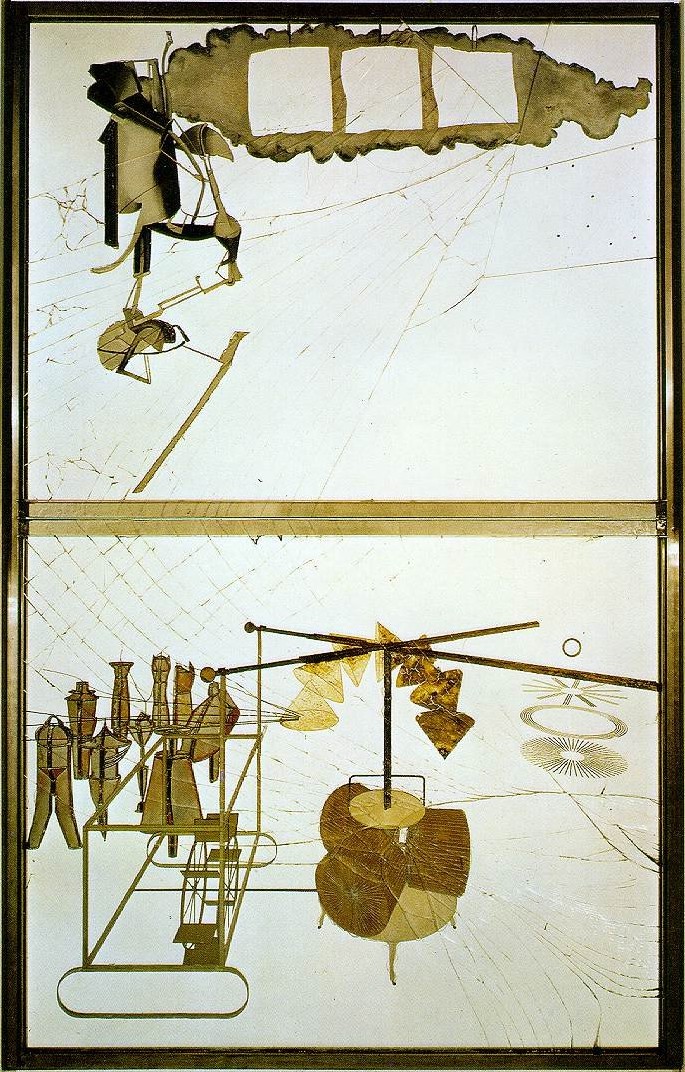
Duchamp is the studio case, not a picture of the physics. The Large Glass, 1915–23, names an event that never finishes: the bride stripped bare. He called the work a delay in glass so it would stop being a painting. You look through two panes. One glance is not the work. The history stays in the delay.
Is the diagram the history, or does the diagram have a history?
Minkowski, “Space and Time,” 1908. He takes the sheet for the object. Space and time are only shadows of that drawing.
Husserl, “The Origin of Geometry,” 1936. The sheet looks timeless because its making was forgotten. Geometry is a dated act, not ideal space waiting to be seen.
The film is the sheet he draws. Husserl’s question is aimed at it.
He treats the drawing as the world. Husserl says the drawing was made, and once you forget that, a diagram starts to look like space itself.
Psi Sound System
Chapter two
The Philosophy of Time Travel
A world-line event. Captured twice, 11 October 2026.07:36 PDT. 07:52 PDT. Both inside 07:30–08:00.
The shape is a closed loop. No one in it is from a story. The note, Minkowski, and Mafia are the physics, and the physics moves.
The line is the only world. The note is in two times at once.
It arrives from further along the line. It is already here.
The panther bends the line. The bend is the travel.
Before the cut, ψ is every line. The cut keeps one note.
The note goes back onto the line. The purr is the close.
Minkowski, the black-matter panther
One figure, not two. He does not shine, so he is not on the light. You hear the lines lean. A bent line arrives as a lower note.
Mafia, the quantum cat
One cat, many lines. Before the cut, ψ is the chord. At the cut, one note. The purr is the physics, read across the packet.
The mouse
The mouse runs the same lines faster. Chaos, held smooth, like the purr. The note was caught twice this morning. The second pass is the mouse.
Each line is one pitch. The gold cut is now. Where a line crosses it, that point is the note.
Read ψ and the high lines arrive first. That sweep is the chirp. Mafia keeps one line. Minkowski, the black-matter panther, leans them flat. The mouse is the chaos engine: the same lines, run fast, smooth as a purr.